
How AI is Revolutionizing Website Development in 2026
The landscape of web development is constantly evolving, but every few years, a technology emerges that doesn't just change the game – it reinvents it. In 2026, that technology is undeniably Artificial Intelligence
Future Digital Hub
10/3/20253 min read
The landscape of web development is constantly evolving, but every few years, a technology emerges that doesn't just change the game – it reinvents it. In 2026, that technology is undeniably Artificial Intelligence. AI isn't just a buzzword; it's fundamentally transforming how we conceive, design, build, and maintain websites, making the process faster, smarter, and more accessible than ever before.
Let’s dive into how AI is becoming the silent partner in every developer's toolkit, from automated coding to intelligent design suggestions.
1. The Rise of AI-Powered Design & Prototyping
Remember the days of endless wireframing and mock-ups? While human creativity remains paramount, AI is stepping in to accelerate the initial design phase.
Intelligent Design Suggestions: AI design assistants can now analyze your brand guidelines, target audience data, and even competitor websites to generate multiple design concepts in minutes. These tools learn from vast datasets of successful websites, understanding optimal layouts, color schemes, and typography for various industries. Imagine inputting your business goals and having several aesthetically pleasing, conversion-optimized design drafts presented to you.
Automated UI/UX Generation: Beyond static designs, AI can generate interactive prototypes. By understanding user flow patterns and common UI conventions, AI can create functional prototypes that you can test with real users, allowing for rapid iteration and significant time savings before a single line of production code is written. This means more time spent perfecting the user experience and less time on repetitive design tasks.
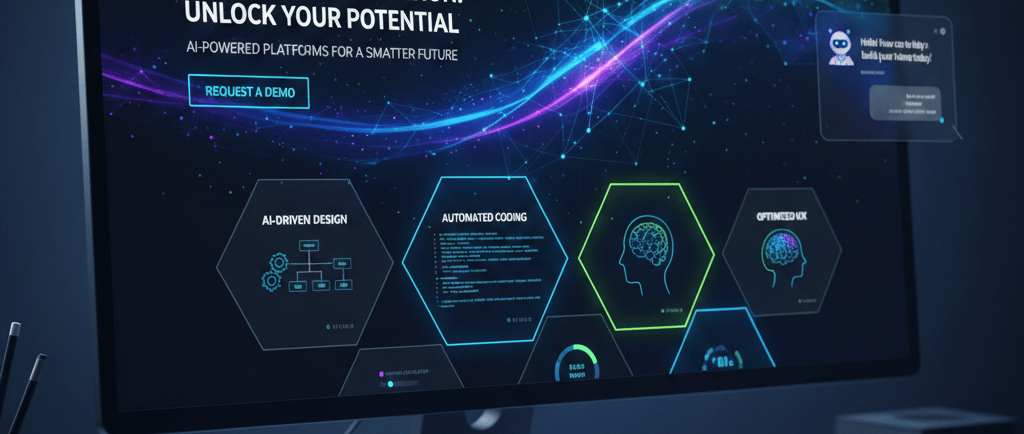
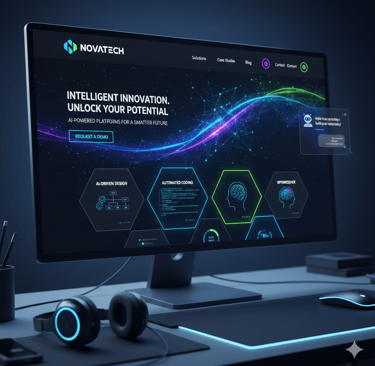
Here’s an example of an AI-generated design concept for a modern tech startup.
2. Automated Coding & Code Generation
Perhaps the most impactful shift is in the realm of coding itself. AI isn't replacing developers, but it's becoming an incredibly powerful co-pilot.
From Design to Code: Tools are emerging that can translate design files (like Figma or Sketch) directly into clean, semantic code (HTML, CSS, JavaScript). These aren't just simple conversion tools; they understand best practices, responsive design, and component-based architectures, significantly reducing the manual effort required to build a site.
Intelligent Code Completion & Refactoring: Advanced AI models can now predict your next line of code with remarkable accuracy, suggest entire functions, and even refactor existing code to improve performance, security, or readability. This means fewer bugs, faster development cycles, and more time for developers to focus on complex problem-solving and innovation rather than repetitive boilerplate.
Bug Detection and Fixing: AI-driven analysis tools can scour vast codebases to identify potential vulnerabilities, performance bottlenecks, and logical errors before they even make it to testing. Some advanced systems can even suggest or automatically implement fixes, streamlining the debugging process.
3. Hyper-Personalization and Adaptive Content
The days of a one-size-fits-all website are rapidly fading. AI is making true personalization a reality.
Dynamic Content Delivery: AI algorithms can analyze user behavior, demographics, location, and past interactions to dynamically display content, offers, and calls-to-action tailored to each individual visitor. This leads to significantly higher engagement rates and conversion metrics.
Adaptive Layouts: Beyond responsive design, AI can now adapt entire website layouts in real-time based on user preferences or device capabilities, optimizing the experience for every single interaction.
Voice UI Optimization: With the proliferation of voice assistants, AI is crucial for optimizing websites for voice search and interaction, ensuring your content is easily discoverable and consumable through audio interfaces.
4. Enhanced Performance & SEO
AI isn't just about how we build; it's also about how well websites perform once they're live.
Predictive Performance Optimization: AI can analyze traffic patterns, server loads, and content delivery networks to anticipate potential bottlenecks and suggest optimizations before they impact user experience. This includes intelligent caching strategies, image optimization, and resource loading prioritization.
AI-Driven SEO Strategies: Search Engine Optimization is becoming increasingly complex. AI tools can analyze search trends, competitor strategies, and content gaps to recommend topics, keywords, and structural improvements that boost your search rankings more effectively than ever before.
Automated A/B Testing: AI can conduct sophisticated multivariate tests on different design elements, content variations, and user flows, identifying the most effective combinations for achieving specific business goals (e.g., higher conversions, longer dwell times) at an unprecedented speed.
5. Smarter Maintenance and Security
The lifecycle of a website extends far beyond its launch. AI is making ongoing maintenance more proactive and robust.
Predictive Maintenance: AI systems monitor website health, identifying potential issues with plugins, integrations, or server infrastructure before they lead to downtime.
Advanced Security Monitoring: AI-driven security tools are constantly learning new threat patterns, providing real-time detection and mitigation of cyber-attacks, far surpassing traditional signature-based methods.
Automated Updates: AI can manage and test updates for CMS platforms, plugins, and frameworks, reducing the risk of conflicts and ensuring your site remains secure and up-to-date with minimal manual intervention.
The Future is Collaborative: AI and Human Developers
It's important to reiterate: AI is not replacing human developers. Instead, it's augmenting their capabilities, freeing them from mundane, repetitive tasks, and allowing them to focus on higher-level strategic thinking, complex problem-solving, and truly innovative solutions.
For businesses, this means faster development cycles, more efficient resource allocation, superior website performance, and ultimately, a better return on investment for their digital presence. In 2026, embracing AI in website development isn't just an advantage; it's a necessity for staying competitive.
Contact Us
Let's build your future digital presence.
support Email:
Admin email:
support@futuredigitalhub.com
admin@futuredigitalhub.com
Website Designed by Future Digital Hub © 2025. All rights reserved.
Our Store
Contact Us
Empowering businesses with cutting-edge website development and AI consulting solutions for the digital age.

